A 250-Year Tribute to American Manufacturing
The founders learned it the hard way. Hamilton put it in writing. COVID proved it again. The country that can make what it needs controls its own future.

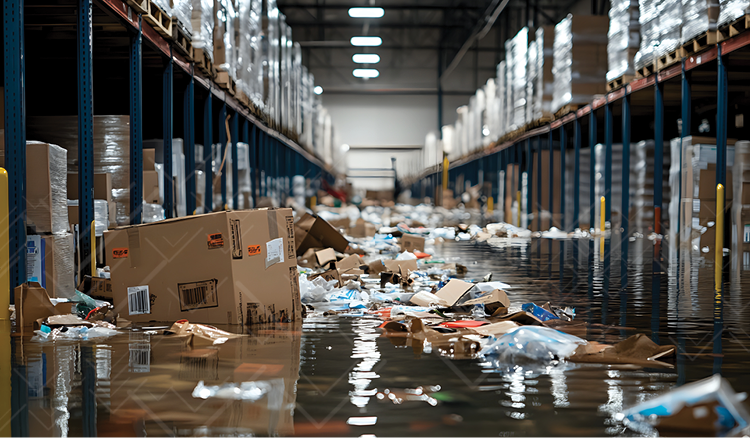
Hurricane season opened June 1st, and NOAA's 2026 outlook calls for a below-average year: 8 to 14 named storms, 3 to 6 becoming hurricanes. That sounds reassuring, but a mild forecast isn't a guarantee. NOAA's National Weather Service Director Ken Graham said as much when the outlook was released: it only takes one storm making landfall in the wrong place to turn into a very bad year for your operation (see 2023, when a "near-normal" forecast still produced 20 named storms). The real peak, mid-September through October, is still ahead.
If you run a manufacturing plant, warehouse, or distribution center on the coast, you spend the summer watching the tropics, mostly for storms that curve out to sea before they matter. But somewhere in the back of your mind is the one that doesn't: the power goes out, the floors flood, half your team can't get to work, and orders keep piling up whether you're open or not.
You can't control the storm. But you can control how ready your operation is when one hits.
A hurricane doesn't hit your operation just once. It hits you in three distinct phases, and each one has a different labor problem attached to it.
Before landfall, you may need to shut down early, board up, and secure inventory, often with less notice than you'd like.
During the outage, you're paying full-time staff to sit at home (or scrambling to figure out whether you can, or should), while the meter on your fixed labor costs keeps running regardless of output.
After the storm passes, the real crunch begins. Power comes back, but not everyone does. Employees are dealing with flooded homes, damaged cars, and family emergencies of their own. At the exact moment you need more hands to clear a backlog, dig out from cleanup, and fulfill delayed orders, your available workforce is often smaller than normal, and your customers don't particularly care that a hurricane is the reason their shipment is late.
Traditional staffing agencies don't flex well for this kind of swing. They need lead time you won't have in an emergency, and they're sending whoever's available that day, often people dealing with their own storm damage who show up out of obligation, not choice. That's exactly the moment good labor gets hardest to guarantee.
Veryable is an on-demand labor marketplace built for manufacturing, warehousing, and logistics operations. Businesses use the platform to post short-term work opportunities, called Ops, for the specific tasks, shifts, and skills they need. Local Operators, vetted independent workers can then bid on the Ops that fit their availability, and the business selects who to bring in based on experience, ratings, and past performance.
That makes Veryable different from a traditional staffing agency. Veryable is not dispatching a random crew to your facility. Operators choose the Ops they want to work, and businesses choose the Operators they want to accept. Over time, that creates a labor pool: a group of proven Operators who have already worked at your facility, understand your expectations, and can be invited back when you need more help.
For hurricane planning, that Labor Pool is the key. It's not extra headcount sitting on payroll or a bench you pay to keep available. It's a flexible network of familiar, work-ready Operators you build through normal operations, before a disruption ever happens.
Most operations need a short burst of extra hands for one list of urgent tasks: securing inventory, boarding up, or pushing through a final production run before the plant goes dark. Post an Op and get help for that day or two of work, without adding anyone to payroll or waiting on an agency to scramble a crew together.
Your variable labor cost drops to zero instantly, no contract penalties, no minimum hour guarantees. Keeping core full-time staff on payroll through the shutdown for retention or morale is still your call, Veryable doesn't touch that decision. What it does remove is the cost of carrying a bench of Ops labor you can't use while the doors are closed, freeing up the margin and runway you'll want for the recovery push once the storm passes.
This is where the model matters most: you need to move fast to clear backlog, get the facility back to full throughput, and catch up on orders, all while some of your own team is still dealing with the aftermath at home.
It's fair to ask whether local Operators are just as exposed to the same storm. They are. The difference is the bidding model: Operators only bid on Ops they can actually work, so the ones bidding on your post-storm shifts are, by definition, the ones who still have power, working transportation, and the availability to take on extra hours, many of them looking for that extra income to cover their own storm expenses. You're not calling a dispatcher and hoping enough names on a list pick up the phone. You're only seeing Operators who are already positioned and motivated to show up, which solves the reliability problem a traditional agency has in the same situation, and lets your own affected employees focus on their own recovery without you losing production capacity to cover for it.
The same flexibility covers the rest of the recovery. Bring in extra hands for cleanup and repairs so your trained team isn't pulled off the specialized work only they can do, and add people on the dock so trucks get loaded and unloaded as soon as they arrive instead of sitting in a lot while highways and schedules catch up.
A Houston based regional consumer products distributor lost power for the better part of a week when Hurricane Beryl came through in July 2024. Many of their full-time staff couldn't make it in, kept home by power outages, property damage, and transportation problems, and the facility and product took damage from flooding.
Because they already had a Labor Pool in place, they didn't have to figure this out on the fly. The week before the storm, they'd posted 341 hours of Ops. During the outage week, that dropped to 107 hours as they scaled down and avoided paying for labor they couldn't use. Over the next two weeks, it climbed to 545 and then 643 hours as they posted more Ops than normal to clear the backlog, getting the facility running ahead of schedule instead of limping back for weeks. Their customers didn't know or care that a hurricane caused the delay, they just wanted their product on time, and a flexible Labor Pool made that possible.
On-demand labor isn't something companies reach for only during a disaster. It's used day to day and week to week to match labor with actual demand:
That's the day-to-day and week-to-week reality behind the model, and it's what quietly builds the Labor Pool you'd lean on if a storm ever hit.
A new company can create a profile and post its first Op the same day, bypassing legacy agency contracts entirely, a speed no traditional staffing agency can match. If a hurricane's already bearing down and you've never used Veryable before, that speed is real, and it's exactly why we can still help when things are already moving fast.
But that capability is a safety net, not a substitute for a plan. Deploying fast during a crisis still means introducing Operators to your facility for the first time, under the worst possible conditions, with no familiarity with your layout, safety protocols, or equipment. That's not a reason to skip Veryable in an emergency. It's the reason not to wait to start building a pool.
Use that same speed now, while there's no storm on the radar, and the equation flips. Get your profile live and post routine Ops for the shifts and gaps you already have, and within a few cycles you have a warm pool of Operators who know your facility, your layout, and how your team runs. Then when a storm hits you're activating a familiar, trusted network with the push of a button.
You can't control whether a storm hits your facility this year, but you can control whether you already have a Labor Pool in place when it does. Start today: post your next busy shift, seasonal push, or coverage gap as an Op, and you're already building the pool that has your back when the weather turns.
Looking for assistance? Check out our quick start guide or get in touch.

Create your free business profile and begin building your on-demand labor pool today.